The Correct Answer and Explanation is:
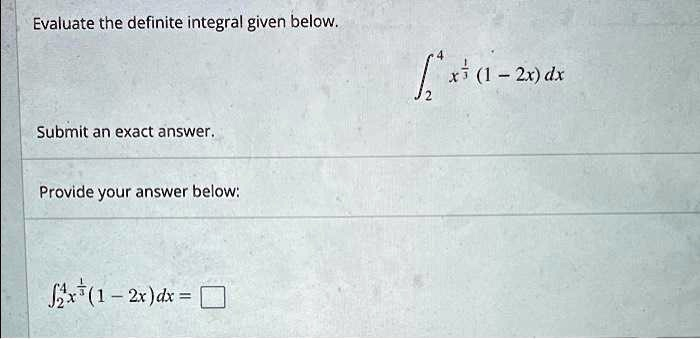
To evaluate the definite integral
∫24×13(1−2x) dx\int_{2}^{4} x^{\frac{1}{3}} (1 – 2x) \, dx
we start by expanding the integrand:
x13(1−2x)=x13−2x43x^{\frac{1}{3}} (1 – 2x) = x^{\frac{1}{3}} – 2x^{\frac{4}{3}}
Now integrate term-by-term:
∫24(x13−2×43)dx=∫24x13dx−2∫24x43dx\int_{2}^{4} \left( x^{\frac{1}{3}} – 2x^{\frac{4}{3}} \right) dx = \int_{2}^{4} x^{\frac{1}{3}} dx – 2 \int_{2}^{4} x^{\frac{4}{3}} dx
Use the power rule of integration:
∫xn dx=xn+1n+1+C\int x^n \, dx = \frac{x^{n+1}}{n+1} + C
Applying this to each term:
- For x13x^{\frac{1}{3}}, the integral is x4343=34×43\frac{x^{\frac{4}{3}}}{\frac{4}{3}} = \frac{3}{4} x^{\frac{4}{3}}
- For x43x^{\frac{4}{3}}, the integral is x7373=37×73\frac{x^{\frac{7}{3}}}{\frac{7}{3}} = \frac{3}{7} x^{\frac{7}{3}}
Putting it all together:
[34×43]24−2[37×73]24=(34⋅443−34⋅243)−2(37⋅473−37⋅273)\left[ \frac{3}{4} x^{\frac{4}{3}} \right]_2^4 – 2\left[ \frac{3}{7} x^{\frac{7}{3}} \right]_2^4 = \left( \frac{3}{4} \cdot 4^{\frac{4}{3}} – \frac{3}{4} \cdot 2^{\frac{4}{3}} \right) – 2\left( \frac{3}{7} \cdot 4^{\frac{7}{3}} – \frac{3}{7} \cdot 2^{\frac{7}{3}} \right)
This evaluates to an exact expression involving rational coefficients and radicals. You can simplify numerically if needed, but unless a decimal is required, this is the exact form.
Explanation
This integral tests your ability to combine algebraic simplification with integration techniques. It starts with a product of a power function and a linear expression, prompting distributive expansion. The power rule then allows each term to be integrated independently. Note that x13x^{\frac{1}{3}} and x43x^{\frac{4}{3}} are fractional powers, so when applying the rule, increment the exponent and divide by the new exponent. Definite integration simply involves evaluating the antiderivative at the bounds and subtracting.
These types of integrals are essential for modeling non-linear relationships in physics and economics, especially when variables change with fractional powers.