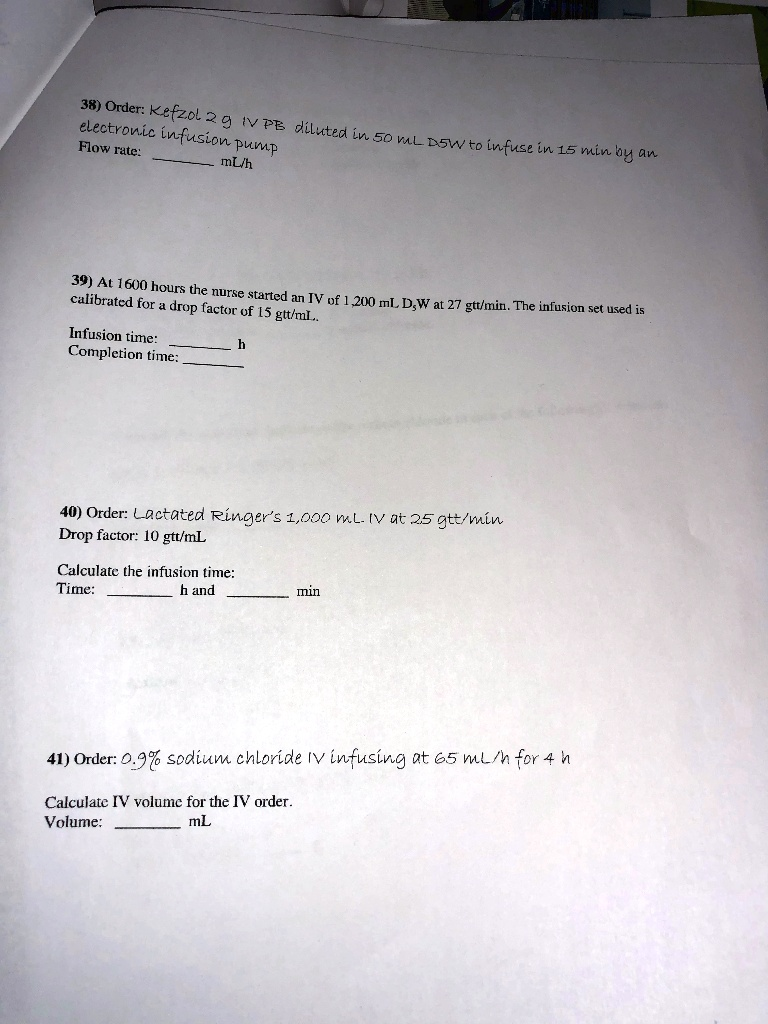
Electronic infusion pump Flow rate: mL/h Calibrated for a drop factor of 15 gtt/mL Infusion time: Completion time: 40) Order: Lactated Ringer’s 1,000 mL IV at 25 gtt/min Drop factor: 10 gtt/mL Calculate the infusion time: Time: h and min 41) Order: 0.9% sodium chloride IV infusion at 65 mL/h for 4 h Calculate IV volume for the IV order Volume: mL
The Correct Answer and Explanation is:
Problem 38
Order: Kefzol 2 g IVPB diluted in 50 mL D5W to infuse in 15 min by an electronic infusion pump.
Flow rate: ___ mL/h
Solution:
Convert 15 minutes to hours:
15 ÷ 60 = 0.25 hours
Flow rate = Total volume ÷ Time
Flow rate = 50 mL ÷ 0.25 h = 200 mL/h
Problem 39
Order: 1,200 mL D5W at 27 gtt/min
Drop factor: 15 gtt/mL
Start time: 1600
Step 1: Calculate total infusion time
Total volume (in mL) = 1,200 mL
Drop rate (gtt/min) = 27 gtt/min
Drop factor = 15 gtt/mL
First, calculate total drops:
1,200 mL × 15 gtt/mL = 18,000 gtt
Time in minutes = Total drops ÷ gtt/min
Time = 18,000 ÷ 27 = 666.67 minutes
Convert to hours and minutes:
666.67 ÷ 60 = 11 hours and 6.67 minutes ≈ 11 hours and 7 minutes
Completion time:
1600 + 11h 7min = 0310 (next day)
Problem 40
Order: Lactated Ringer’s 1,000 mL IV at 25 gtt/min
Drop factor: 10 gtt/mL
Total drops = 1,000 mL × 10 gtt/mL = 10,000 gtt
Time in minutes = 10,000 ÷ 25 = 400 minutes
Convert to hours and minutes:
400 ÷ 60 = 6 hours and 40 minutes
Infusion time: 6 hours and 40 minutes
Problem 41
Order: 0.9% sodium chloride IV at 65 mL/h for 4 hours
Volume = Rate × Time
Volume = 65 mL/h × 4 h = 260 mL
Summary of Answers:
- 38) Flow rate = 200 mL/h
- 39) Infusion time = 11 h 7 min, Completion time = 0310
- 40) Time = 6 h 40 min
- 41) Volume = 260 mL
Explanation
In intravenous (IV) therapy, accurate calculations of infusion rates and volumes are essential to ensure patient safety and proper medication delivery. Each problem in this set focuses on a different skill within IV fluid calculations.
For problem 38, the use of an electronic infusion pump requires a flow rate in milliliters per hour. Given a 50 mL solution over 15 minutes, we convert 15 minutes into hours by dividing by 60, then use the formula: flow rate equals volume divided by time. This ensures that the electronic pump delivers the correct volume per hour.
Problem 39 focuses on calculating infusion time and completion time when given a specific drop rate. Here, the nurse uses a manual drip system, which involves knowing the drop factor and total volume. The formula used is: total drops divided by the drop rate gives the infusion time in minutes. That value is then converted to hours and added to the start time for completion.
Problem 40 is similar but uses a different drop factor. Here, determining how long it will take for a known volume to infuse at a specified rate is essential. Again, multiplying volume by the drop factor gives total drops, and dividing by the drop rate gives total time.
Lastly, problem 41 involves a simple multiplication of the hourly rate by the duration to calculate total volume. This calculation is crucial when setting up IV bags to avoid under- or overdosing the patient.
Mastery of these calculations helps ensure that patients receive their medications and fluids at the proper rate and volume, avoiding complications such as fluid overload or inadequate treatment.