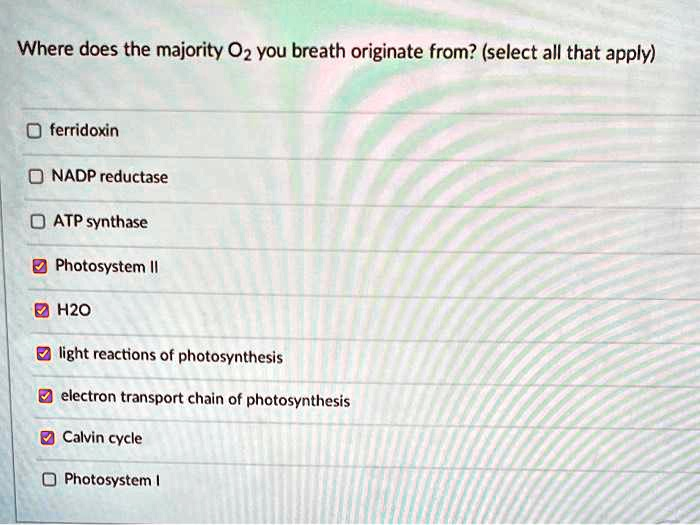
Where does the majority O2 you breath originate from? (select all that apply) ? ferridoxin ? NADP reductase ? ATP synthase ? Photosystem II ? H2O ? light reactions of photosynthesis ? electron transport chain of photosynthesis ? Calvin cycle ? Photosystem I
The Correct Answer and Explanation is:
Correct Answers:
- ✅ Photosystem II
- ✅ H₂O
- ✅ Light reactions of photosynthesis
Explanation:
The majority of the oxygen (O₂) you breathe originates from the light reactions of photosynthesis in plants, algae, and cyanobacteria. These reactions occur in the thylakoid membranes of chloroplasts and require sunlight, water (H₂O), and chlorophyll.
The actual release of molecular oxygen occurs when Photosystem II absorbs light energy. This energy excites electrons in chlorophyll molecules, and to replace those electrons, Photosystem II splits water molecules in a process called photolysis. This reaction is catalyzed by the oxygen-evolving complex, which is part of Photosystem II.
The photolysis of water is as follows:2H2O→4H++4e−+O22H₂O → 4H⁺ + 4e⁻ + O₂2H2O→4H++4e−+O2
This is the direct source of the atmospheric oxygen that organisms use for respiration. Without this reaction, there would be no substantial oxygen released into the environment.
While the electron transport chain of photosynthesis and Photosystem I also play roles in the light reactions, they do not directly contribute to the release of oxygen. The Calvin cycle, on the other hand, is part of the dark reactions and is focused on carbon fixation. It does not produce or release oxygen.
Other components listed:
- Ferredoxin and NADP reductase are involved in electron transfer and the formation of NADPH, not in oxygen production.
- ATP synthase uses the proton gradient to generate ATP but does not produce O₂.
Therefore, Photosystem II, H₂O, and the light reactions of photosynthesis are the correct answers, as they directly lead to the oxygen you breathe.