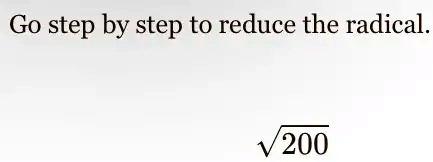
Go step by step to reduce the radical.
The Correct Answer and Explanation is:
To reduce the radical expression √200 step by step:
- Prime factorize 200 Start by breaking 200 into its prime factors: 200 = 2 × 100 100 = 2 × 50 50 = 2 × 25 25 = 5 × 5 So, 200 = 2 × 2 × 2 × 5 × 5 = 23×522^3 \times 5^2
- Apply the square root to the factorization √200 = √(2 × 2 × 2 × 5 × 5) Rearranged as √(2² × 5² × 2)
- Separate into known square roots and remainder √200 = √(2²) × √(5²) × √2 √(2²) = 2, √(5²) = 5, and √2 remains
- Multiply the constants 2 × 5 = 10
Final simplified answer: √200 = 10√2
Explanation:
When simplifying a radical, the goal is to express the number inside the square root in terms of perfect squares multiplied by any leftover non-square factors. In this case, the number 200 is not a perfect square itself, so we look for factors of 200 that are perfect squares. We start by decomposing 200 into its prime components: three factors of 2 and two factors of 5. From this, we identify that 222^2 and 525^2 are perfect squares.
Using the property that the square root of a product equals the product of the square roots, we separate the perfect squares and pull them out of the radical. Each square root of a perfect square becomes a whole number outside the radical. The leftover 2, which is not part of a square pair, remains under the square root sign.
This simplification process transforms the square root of a composite number into a cleaner expression that’s easier to handle in equations or further algebraic work. The result, 10√2, is fully simplified because √2 is already in its simplest radical form. This method is broadly applicable in both pure and applied mathematics, making radical simplification a key tool in problem solving